
How I Work
Play Therapy for Children
Entering the Child’s World
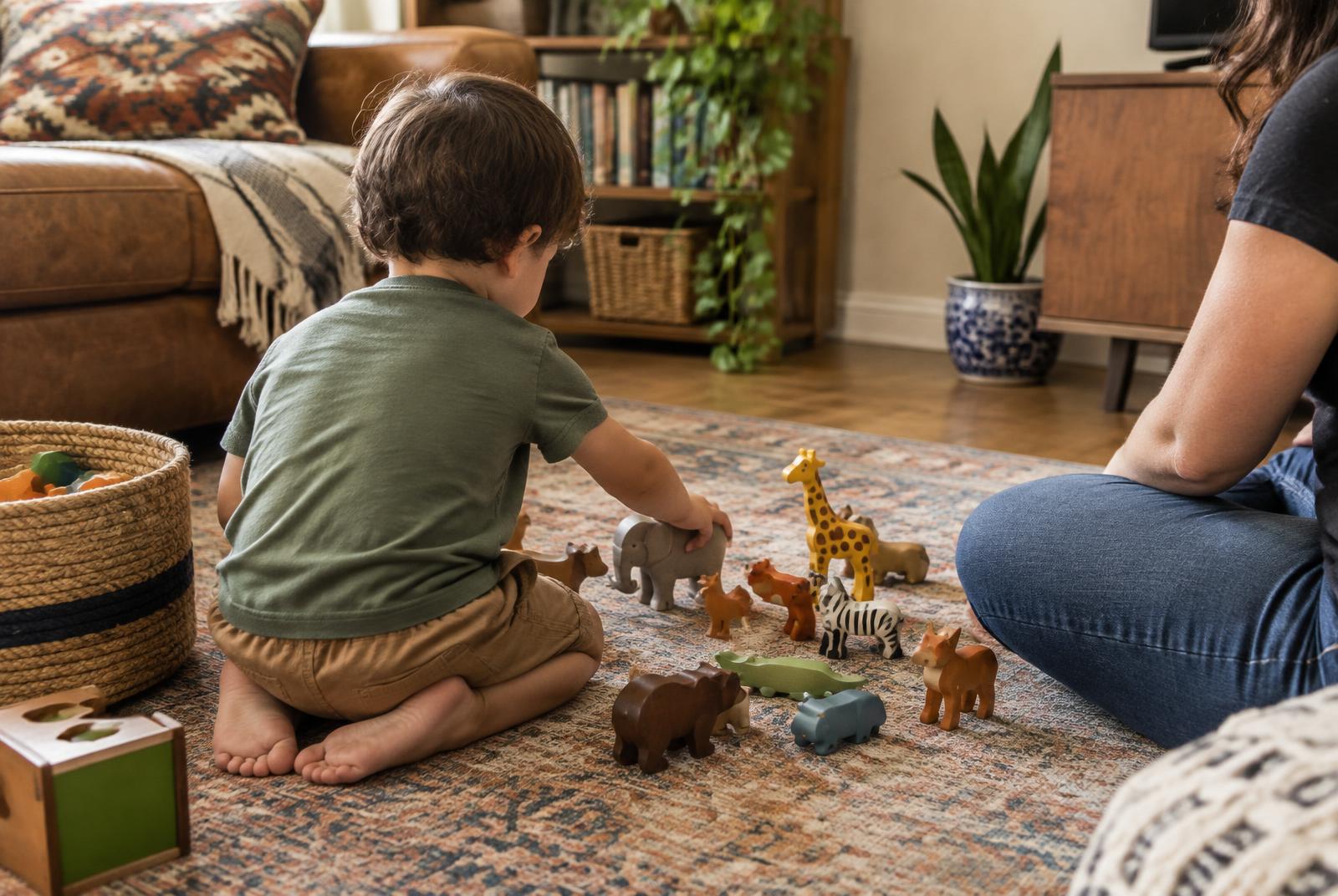
Play can be almost anything. It can be dolls, trucks, dinosaurs, action figures, board games, sports, crafts, Legos, pretend play, or video games. For a lot of kids now, video games are pretty crucial. Part of play therapy is entering the child’s world, because you really cannot understand somebody very well if you are not willing to get into their world with them.
And sometimes even the trucks talk.
A couple of dinosaurs may be fighting and I may ask, “Why are they fighting?” Maybe they are fighting because dinosaurs had to fight for food, but then that can turn into, “Do we fight with our friends?” or “How do you think that dinosaur felt?” I have had kids who love playing with the Joker, and then we get into things like, “Why did the Joker decide to do that?” “Why did he decide to be the bad guy?” “What does he want?” We are talking about a character, but at the same time we are building emotional vocabulary, perspective-taking, and an understanding of why people do what they do.
Sometimes it is easier for a child to tell me how a character feels than to tell me how they feel.
Games and Big Feelings
Games give us a whole different set of things to work with. Kids get to practice taking turns, following rules, changing rules and understanding that if you change the rules, everybody has to agree to the new ones. They get to practice winning and losing. Wanting to win is normal. You are supposed to want to win. But you do not have to lord it over everybody when you do. And losing can be really disappointing without being a crisis.
Sometimes I will deliberately act out losing and throw a ridiculous pretend tantrum, and the kids usually laugh because they can see that my reaction is way too big for what happened. That gives us a way to talk about what I think of as the volume or temperature of an emotion. Feelings are information. Feelings are energy. They are valid. But just because we have a huge feeling about something does not mean we have to turn it into a huge crisis.
A child can be very disappointed about losing a game and still not have to hit, kick, throw the game, or ruin it for everybody else. They can say, “I need a break.” They can decide they are too overwhelmed to keep playing right now. Those sound like tiny little skills, but they really are not.
Repetition and the Gwens
Children also repeat things. They want the same book again. They want the same television episode again. They may want to get out the exact same toys and play the exact same thing every time I come. That can drive adults a little nuts, but repetition is developmentally normal. There is predictability in it, and there can be safety in knowing exactly how the story is going to start.
I have worked with autistic kids who want the exact same toys every time. One child always gives me the two Gwens from Spider-Man and keeps all the other characters. Apparently, I get the Gwens. That is just how this world works.
But what I also pay attention to is when the story changes.
I remember children who almost always wanted to play superheroes. The action figures were fighting all the time. That was their play vocabulary. Then one day, one of the children shifted into doctor-and-hospital play and started taking care of someone. It did not suddenly turn them into a child who only wanted to play hospital. They were perfectly happy to go back to having superheroes beat each other up later. But that one day mattered to me because something had appeared in the play that had not been there before: caretaking. Concern. Empathy. Another way of being with somebody.
Sometimes progress looks like that. It is not always a dramatic change. Sometimes the child’s story just gets one more possibility.
A Story She Could Control
Sometimes play therapy looks ridiculous if you do not know what is happening.
I worked with a child in an adoptive home who was deeply afraid that her biological mother might come and take her away. We played out versions of that fear over and over. At one point, what an adult walking into the room would have seen was a child hiding under her bed and a grown woman who did not remotely fit under the bed halfway wedged underneath it with a makeshift blanket “skirt” on, helping her hide from the wicked mother who was coming to find her.
It looked silly. But it was not meaningless.
She was taking something frightening and putting it into a story she could control. She was deciding where to hide, what happened next, who was with her, and how the story ended. And she was not processing that fear alone. I was there with her inside the story.
That is part of what play therapy can do. It gives children a way to take something that feels huge and terrifying and make it small enough to hold, move around, repeat, change, and eventually experience differently.
Zombies and a Stop Signal
I have also worked with children who were having nightmares after frightening experiences. Their fear had somehow become a fear of zombies, and because they loved Dora the Explorer, we borrowed something familiar from that world. We practiced putting up a hand and saying a version of “Swiper, no swiping” to the zombies, essentially giving them a stop signal and an action they could take.
We practiced it over and over in play, and I told them that sometimes, if you rehearse something enough while you are awake, your brain may be able to use it in a dream too. Not every time, and not like magic, but sometimes. The point was to give them a sense that even in the middle of fear, they might have something they could do.
To an adult, this might look like kids waving their hands at imaginary zombies. But underneath that, they were practicing agency, boundaries, and a response to fear.
Play Is Not a Literal Transcript
Children can also use play to work through things that have happened to them. Some kids will tell the same kind of story over and over and over again through their play, just like they may ask you to read the same book fifty times. Sometimes they need to keep telling the story until something about it changes.
But play is not a literal transcript. I am not going to see a dinosaur do something and announce that I now know exactly what happened in a child’s life. Play is more like metaphor or allegory. I look for patterns. I notice themes. Sometimes I ask questions. Sometimes I just make a mental note that something happened. Sometimes it gives me something I may want to talk with a parent about later.
Play Changes as Kids Get Older
Play does not necessarily disappear when kids get older. It just changes.
I have had kids who were really interested in Guts from Berserk. That is not something I would choose to watch myself, and it is definitely not something I would introduce to a child. But some kids are drawn to it because they notice the themes themselves. They talk about resilience, trauma, survival, anger, loss, and what happens to people after terrible things happen. If that is the story they are already bringing into the room, then I can work with the meaning they are finding in it.
The same thing happens with video games in general. Sometimes the content gives us something to talk about. Sometimes the game itself does. A kid may get frustrated when they have to respawn in Fortnite, but they usually keep playing. That gives me a chance to ask why “respawning” on a math assignment feels so much harder.
Controller Lessons
And sometimes the therapeutic value is simply that they get to be the expert.
Kids have tried to teach me to work video game controllers. Many times. It rarely goes well. Sometimes they look at me like, This is not working. You cannot do this. You are not good at this.
And honestly, sometimes it is just funny.
But underneath that, something useful can happen. They get to be competent. They get to teach me something. They get to show off a skill or strength that belongs to them. They get to experience the fact that there are things they can do much better than I can.
What I find especially interesting is that even kids who struggle in other areas usually do not sit there and ridicule me when I am completely incompetent with the controller. A lot of them actually start trying harder to help me. They slow down. They explain it again. They look genuinely sorry for me because apparently I am hopeless.
That gives me a chance to see their empathy.
It also gives them a chance to practice it. They get to experience that different people have different interests, different skills, and different abilities, and that this is okay. Being better at something than another person does not mean you are better than that person. Struggling with something does not mean there is something wrong with you.
TikTok Homework
Sometimes I have to get a little more creative.
I worked with one teenager who had become pretty resistant to therapy. She was much more interested in making and watching TikToks than sitting there talking to me. So instead of fighting that, I used it. Her homework for a while was to make two short TikToks during the week that showed a feeling she had experienced, and then bring them back so we could talk about what was happening.
Did it work perfectly every week? No.
Did it sometimes give us more to work with than asking, “So, how did you feel this week?” Absolutely.
That is really the larger idea. Whatever a kid is interested in, I am looking for ways to use it. I am not trying to drag them into my world and make them do therapy the way adults think therapy is supposed to look. I am trying to meet them in theirs.
Adults Play Too
And play-based therapy does not necessarily stop with teenagers either. Adults play too, even if we do not always call it that. I have used coloring, movement, music, imagery, mindfulness exercises, role-play, humor, and even dancing out a feeling or situation with adults. Sometimes people can get somewhere through movement, metaphor, creativity, or playfulness that they cannot reach by sitting still and trying to explain everything with words.
Planning a First Step
Children can meet virtually across Texas when that format fits them. In-home sessions may be available in Killeen, Copperas Cove, Temple, and nearby communities when meeting in familiar space makes sense for the child and the work.
Tell me a little about your child's age and what has been happening when you send a message. I schedule directly, so we can think through the setting and timing together. A free 15-minute introductory conversation is available if you want to ask how play might fit your child before we make a plan.
Keep Exploring